More enquiries is not the same as more good work.
Agencies rarely lose money on the work they turn down. They lose it on the work they take.
The question underneath all four is not can we win this? It is should we want to? — and it is not a question a pipeline tool can answer, because the answer depends on the agency.
One decision, and the facts it was made from.
Every completed session ends in one decision, and the counted facts behind it. Not a score — an action, with the evidence it rests on and how much of it there is.
Send a proposal
Strong commercial fit- Nothing is outstanding — this is ready to quote.
Clarify first
Not enough evidence yet- Budget must be established before this can be decided.
- No clear budget has been stated yet.
Revisit the price
Strong commercial fit- The budget sits below the £38,000–£52,000 your comparable work has closed at.
Re-scope before quoting
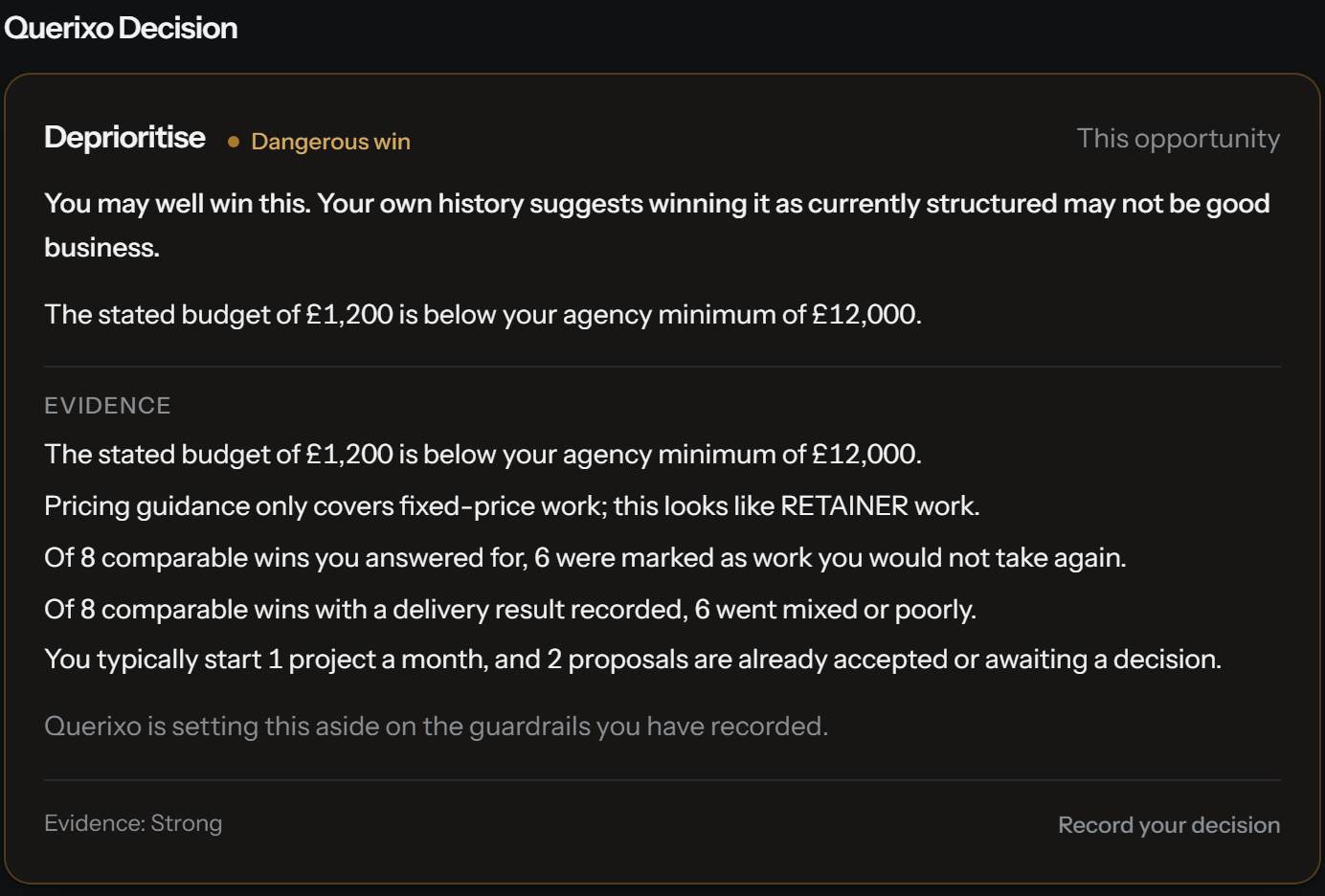
Poor fit- The stated budget of £7,500 is below your agency minimum of £12,000.
Re-scope before quoting
Dangerous win- Of 6 comparable wins you answered for, 4 were marked as work you would not take again.
- Of 6 comparable wins with a delivery result recorded, 4 went mixed or poorly.
- Nothing is outstanding — this is ready to quote.
Five illustrative enquiries for one imagined agency. The names and figures are invented; the decisions are not — each one is produced by the same engine the product runs, from the evidence shown.
Querixo can disagree with you — and show you why.
Every decision opens onto the counted facts it was made from: which guardrail matched, what the budget was against your floor, how many questions are still unanswered, what comparable work closed at. Nothing rests on a confidence percentage, because a model’s certainty about its own answer is not evidence.
You can overrule it in one click. Querixo records that you did.
- The stated budget of £4,000 is below your agency minimum of £12,000.
- Three questions are still unanswered.
- Of 6 comparable wins you answered for, 4 were marked as work you would not take again.
That third line is the one agencies stop at. A deal can be winnable and still be bad business. Querixo calls it a Dangerous Win, and it can only say so once you have recorded how finished projects actually went.
Illustrative figures from the seeded demo agency, not a customer.
A deal can be winnable and still be bad business.
Most sales software answers one question well: can we win this? It is the right question, and it is not the only one. Querixo asks the one an agency owner asks second, usually too late — should we want to win it like this?
Not walk away. The work needs different terms or a different shape before it fits what this agency has learned about itself — which is a conversation to have now, while it is still a conversation.
Winning revenue and winning good work are not the same thing, and only one of them is visible in a pipeline.
Querixo remembers the decision, not just the deal.
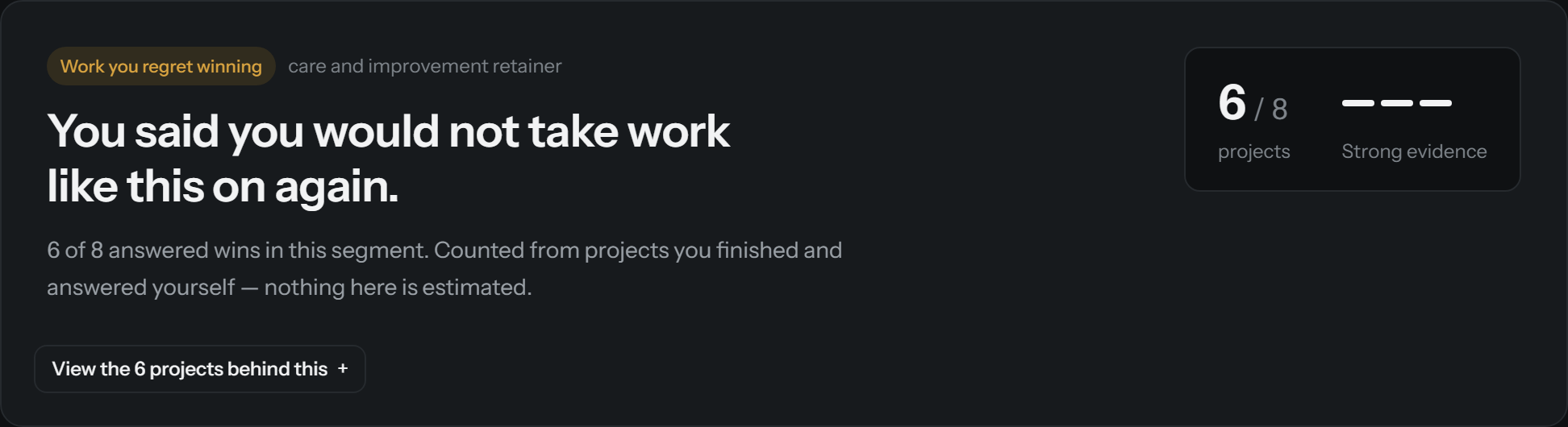
Most systems record whether you won. Querixo records what it recommended, what you decided, whether it was won, how the work actually went, and whether you would take that kind of work again. Five facts, kept together, about one opportunity.
None of this is required to start. From day one Querixo decides from your Brain, your pricing and the conversation in front of it. Recorded outcomes are what let it eventually say something no general model could — that work like this, at your agency, is worth having.
From enquiry to outcome — then back into the next decision.
Querixo does not stop when the work is won. It records what happened after the decision — including whether you would take that work again — and future decisions use more of your agency’s own recorded evidence because of it.
- 01DiscoveryAn enquiry answers questions in your brand, one at a time.
- 02EvidenceAnswers become structured, verified facts — not notes.
- 03DecisionPursue, clarify, re-scope, price, propose or let go, against your guardrails.
- 04ActionThe commercial move: pricing, the proposal, and the choice you actually make.
- 05OutcomeWon or lost, how delivery went, and whether you would take it again.
- 06Outcome MemoryEnough comparable outcomes become a pattern, with the projects behind it.
Most systems remember whether you won. Querixo remembers whether winning was good for you.
A CRM records what happened. Querixo helps decide what should happen next — and then learns from what actually happened, so the decision after this one is made with more than an opinion.
This starts empty. Outcome Memory is built from work you have actually finished, so it says nothing at all until you have closed a few projects and answered two questions about them — and it will keep saying nothing rather than guess.
How Querixo knows enough to decide.
The evidence captured in the first conversation is the same evidence the decision is made from, the same evidence that prices the proposal, and the same evidence that briefs delivery. Nothing is re-typed, and nothing is inferred twice.
Discover
9 questions · answered in the client's own timeSend a link or embed the widget on your own site. One question at a time, in your voice, each one shaped by the answer before it. The client never fills in a form.
Discovery is how the evidence gets gathered.
A chatbot answers questions. Querixo is doing something else while it talks: reading each answer against your services, your prices and your past projects, and writing structured evidence you can act on. The conversation is the easy half.
The conversation is handed to the client before it is written to the database. Nobody waits on our bookkeeping.
The discovery surface renders in your brand and says plainly that it is running intake for you. Hiding it would be the fastest way to lose the trust the conversation depends on.
Modern, creative or corporate. Different question sets and different surfaces, not one template recoloured.
It gets better because it knows your agency, not because the model got bigger.
Import your own site and Querixo builds the Brain: what you sell, what it costs, who you are good for, and what you decline. Those are the guardrails every decision is measured against, and the half you declare. What Querixo observes is the other half — see Decision Memory above.
When the decision is propose, the draft is already waiting.
Scope, phases, deliverables, exclusions and fee, written from the transcript and your own past proposals. You edit rather than start.
Delivery starts with the context already organised.
When a proposal is accepted, Querixo writes the handover — everything delivery needs that never made it into the proposal. Then it steps back. Nothing here tracks progress, because the moment it did, this would be pretending to be a project tool. It comes back once, after the work is done, to ask how delivery went and whether you would take that kind of work again — and those two answers are the whole of what it keeps.
It is not a CRM. It does not manage the project, track time or invoice. It hands the pack to wherever the work actually gets run, and gets out of the way.
Eight parts of one system.
Discovery isn’t one feature bolted onto a form — it’s a straight line from a prospect’s website through the conversation, the evidence it produces, the verdict, the proposal and the handover. Nothing below is a mock-up of a plan; it’s what the running product actually does at each step.
One question at a time, in your voice, shaped by every answer before it — and it is already reading each answer for the facts that matter while the client just sees a conversation.
Paste a domain and it reads their site before you ever speak — claims about the business, each with the sentence it came from.
“Everything goes through the aggregators and we lose 18% on every room.”
Loose talk becomes named fields, merged turn by turn. An empty answer never overwrites something already known.
One recommendation from your own guardrails and closed work — with the counted facts behind it.
Scope, phases, exclusions and a fee band, drawn from the transcript and your own past proposals.
What each side owes, what is blocking, and every risk flagged during discovery. Then it steps back while you deliver.
One script tag puts discovery on your own site as a bubble. Scroll-locked, full screen on mobile, and it cannot leak styles either way.
Owner, admin, manager and member. Everyone sees the same opportunity, and nobody can act on a role they do not outrank.
What using it actually feels like.
Three questions, in the order you ask them each morning: what is waiting on me, what is the pipeline worth, and what happened while I was away.
The workspace is dark because it is a decision surface, not a document — verdicts, figures and queues. Everything your client sees stays light and in your brand.
Your client never sees a form.
They open a page in your brand and answer in their own words. Three templates render the same conversation — choose one, set a colour and a logo, and it is yours. Send it as a link, or embed the same conversation on the site you already have.
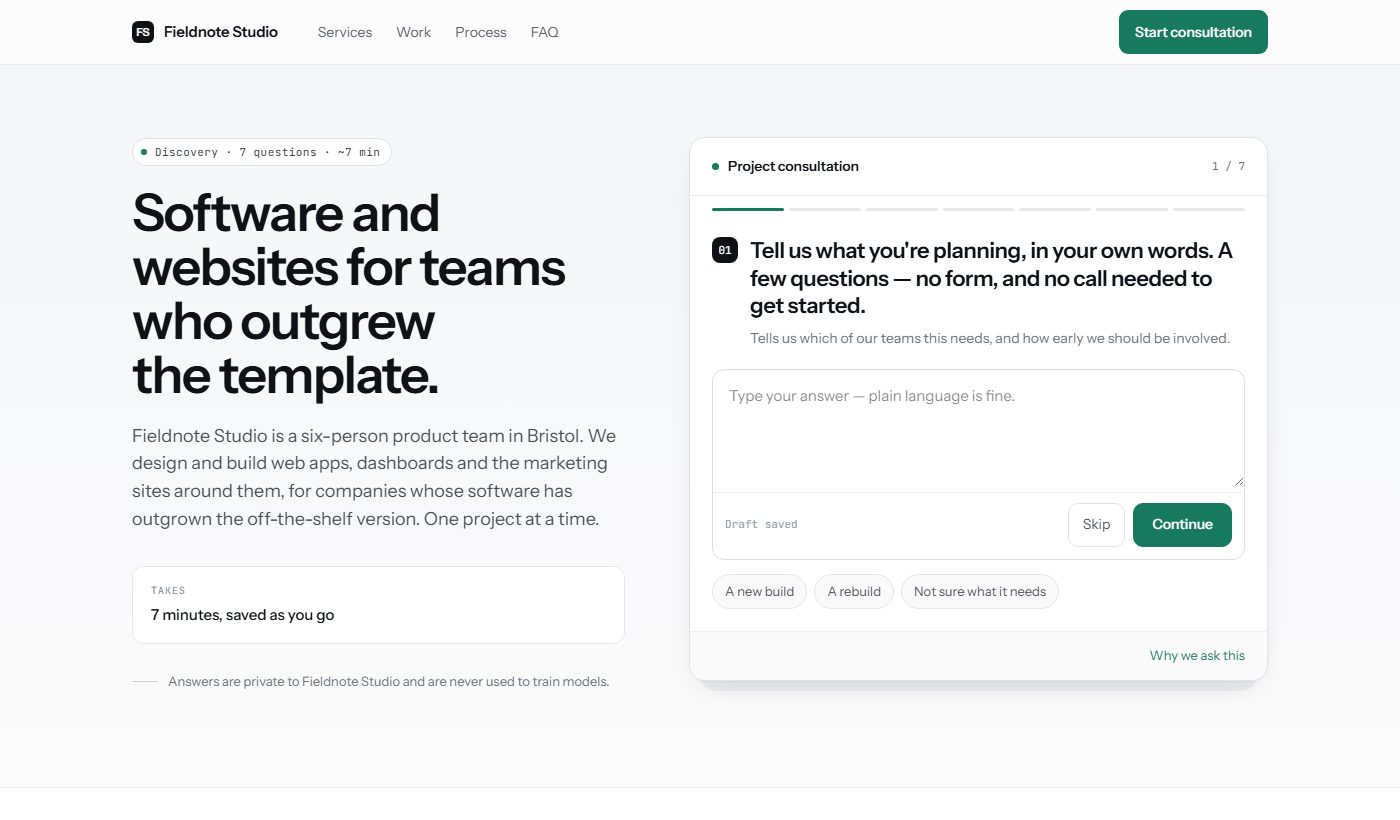
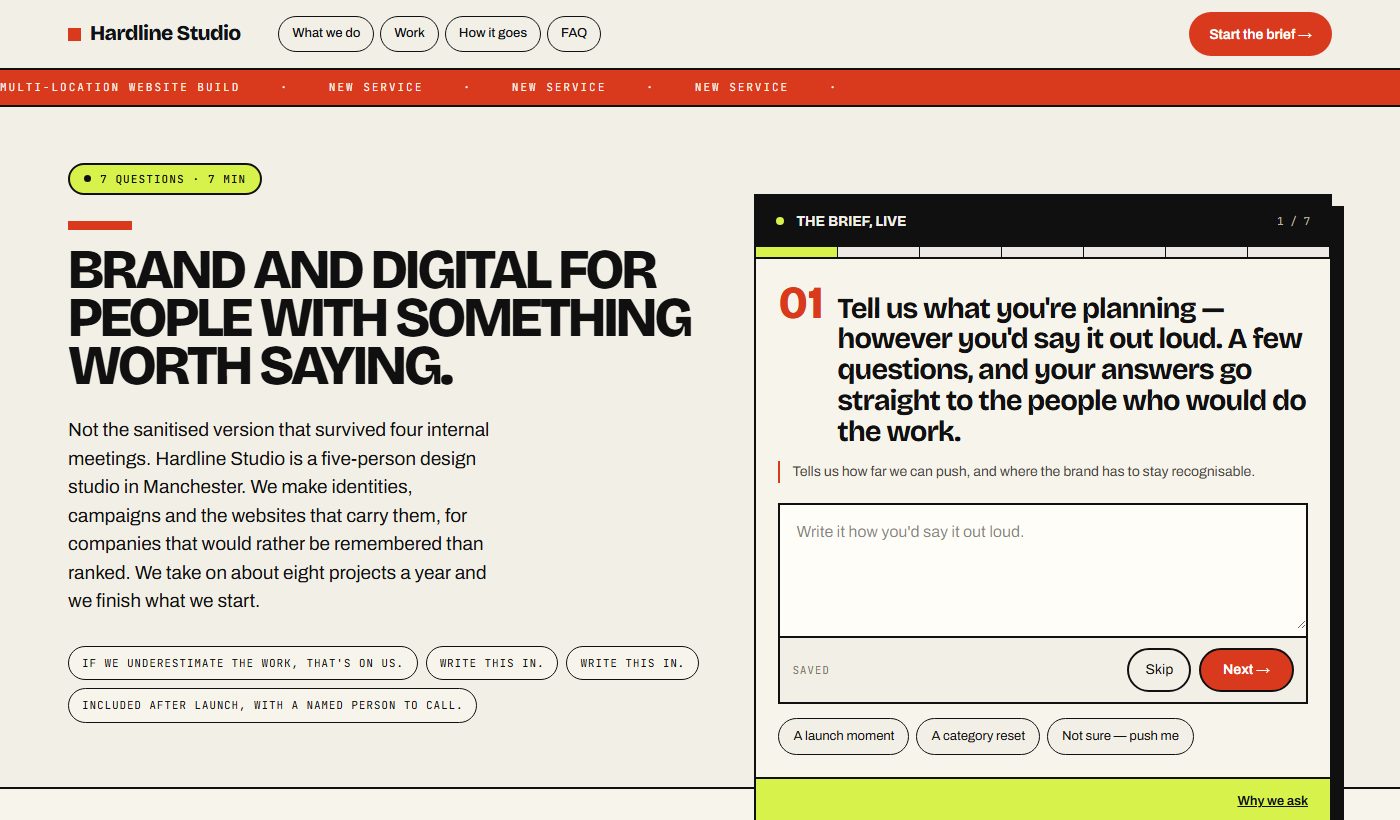
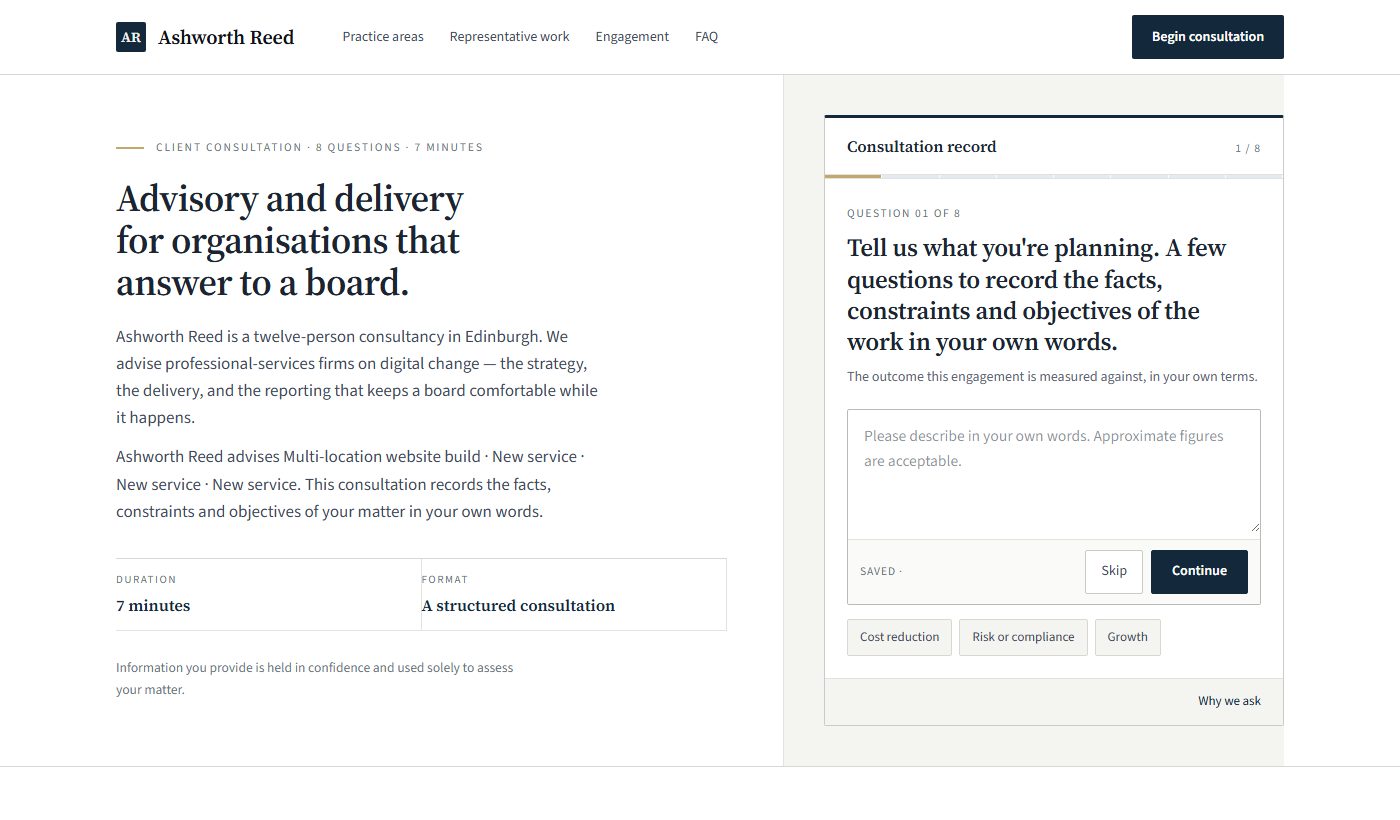
Each question follows from the last one they answered. A form asks all seven of everyone, and gets four back.
Template, colour, logo and wording belong to the agency. Nothing on the page carries our name.
One address you can send, or the same conversation in the corner of your own site. It is one session either way.
Every answer arrives as evidence on the brief you read. Your client is only ever having a conversation.
Priced on completed intakes, not seats.
A client who opens the page, types one line and leaves costs you nothing. Only completed conversations count. Every plan includes unlimited teammates.
Start with 14 days or five completed intakes, whichever comes first. No card.
A steady trickle of enquiries
When enquiries are the constraint
High volume
Plan names, prices and features render from plans.ts. We do not sell unlimited AI — Scale is generous fair-use headroom, not a promise the backend cannot meter.
The ones agencies actually ask.
Does the client know they are talking to AI?
Yes. The discovery surface renders in your brand and says plainly that it is an assistant running the intake for you. Hiding it would be the fastest way to lose the trust the conversation depends on.
Where does the pricing come from?
Your own closed projects. You tell Querixo what you delivered and what you were paid, and it matches new scope against that history — never an industry benchmark, because your rates are not the industry's.
What happens after the proposal is sent?
Querixo writes the kickoff handover when it is accepted, then stays out of the way — it does not manage the project, track time, or replace your CRM. It comes back once, when the work is done, to ask how delivery went and whether you would take that kind of work again. Those two answers are what Outcome Memory is built from.
Can I edit the questions it asks?
Yes. You set the personality and the question set, and you can rewrite or remove any question. Each answer still shapes what comes next.
Will it look like our brand?
Every client-facing surface renders with your logo, type and colour, and stays identical whatever light or dark preference the visitor has set.
Is the AI usage really unlimited on Scale?
No — and we would rather say that plainly than sell you something we cannot back up. Scale includes 150 credits a month, generous fair-use headroom for a single-workspace agency, with top-up packs for genuine outliers. Promising unlimited when the backend meters would be a lie with an invoice attached.
What do you do with our client data?
It stays yours. One workspace, one tenant — handling is documented, not badged, and security details live on the security page rather than a marketing summary.
Spend your agency
on the right work.
Fourteen days or five completed intakes, whichever comes first. No card. Point it at your own site and it will know what you sell, what you charge and what you decline before your first conversation.